
The Future of Adaptation Funds
in Global Sport: A Framework for
Climate-Resilient Tournaments
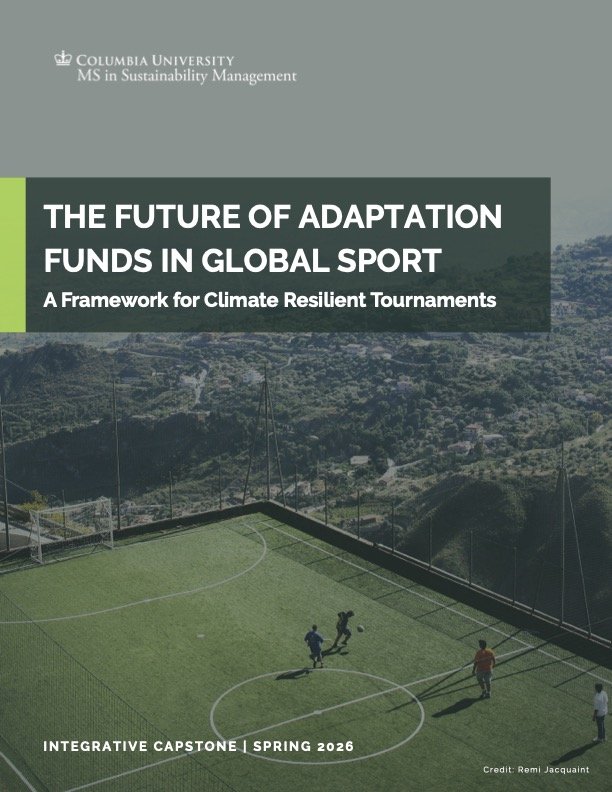
In partnership with the Columbia Climate School, Football For Future commissioned a landmark research framework exploring how global football tournaments can channel climate adaptation funding to grassroots communities on the frontlines of climate change.
The report, developed by a 12-member graduate team through Columbia’s Capstone Workshop, proposes a seven-pillar framework for tournament organisers to establish, govern, and distribute climate resilience funds. Applied to the 2026 FIFA Men’s World Cup, it identifies extreme heat, flooding, and drought as the three priority impact areas across 16 host cities, and recommends a Legacy Resilience Fund to be launched at the tournament’s conclusion.
The framework is built around seven key pillars:
Mission: Anchoring the Fund’s size to the tournament’s financial and climate footprint through a share of revenue and/or per-ton emissions contributions, and pairing this with a needs-based assessment.
Governance: Managing the Fund through a governance board that balances sport and community representation.
Donors: Engaging with only high-quality, reputable sponsors and donors whose internal operations align with the Fund’s climate and community purpose.
Impact: Defining eligible impact areas, such as extreme heat, flooding, severe weather, drought, air quality, and extreme cold, through localised climate risk assessments for host cities.
Eligibility: Establishing clear, published eligibility criteria for both projects and applicants, covering alignment with impact areas, project duration, connection to sport, and exclusions.
Reporting: Requiring all funded organisations to submit a baseline report, annual progress reports, and a final impact report with standardised indicators and third-party verification.
Implementation: Launching the Fund through a centralised public website and a structured communications and outreach plan.
The report then applies the framework to the 2026 Men’s World Cup, recommending a hybrid distribution model that guarantees a baseline allocation per host city, with additional risk-based funding for higher-exposure cities.
“Football holds up a mirror to society, and it is encouraging to see the game beginning to respond to a changing climate. As extreme weather events intensify, climate adaptation is essential, not only to protect football and the communities around it, but to position the game as a leader, inspiring other sectors to respond with proportionate climate action.”
Elliot Arthur-Worsop, Football For Future Founder